The Problem with Reactive Retention
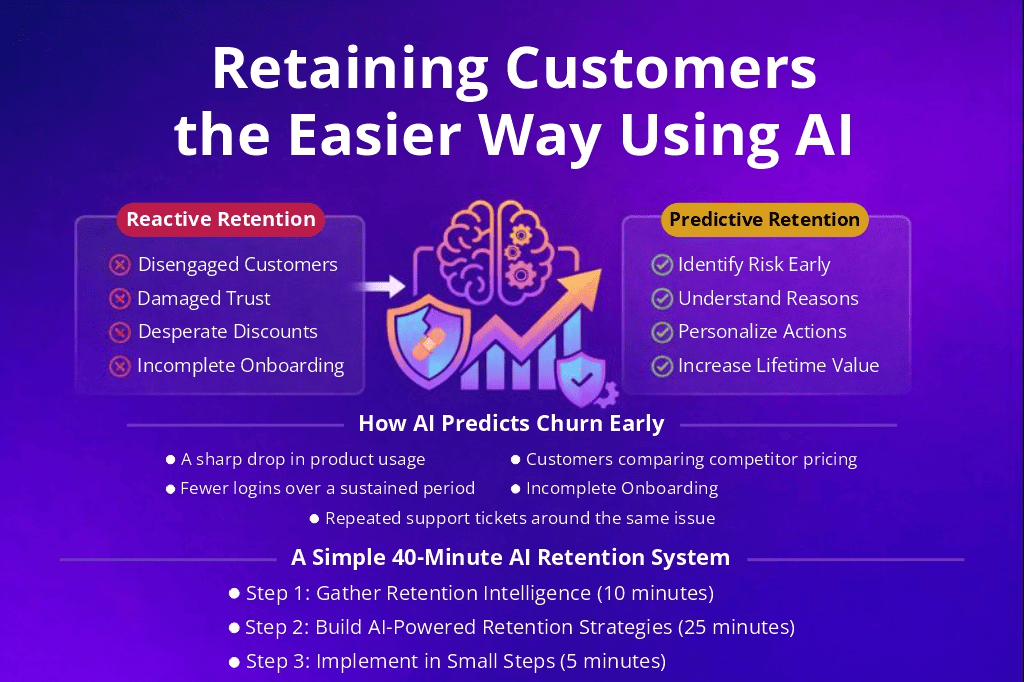
Most retention strategies kick in after the warning signs are obvious. At that stage:
- Customers are emotionally disengaged
- Trust is already damaged
- Discounts feel desperate, not helpful
AI-driven teams work differently. They focus on predictive retention, which means:
- Identifying churn risk weeks in advance
- Understanding why each customer may leave
- Personalizing actions based on real behavior
- Increasing lifetime value proactively
The difference is clear:
Reactive retention tries to save relationships. Predictive retention strengthens them.
How AI Predicts Customer Churn Early
AI looks at patterns humans usually miss.
By analyzing past churned customers, AI can detect early warning signals such as:
- A sharp drop in product usage
- Fewer logins over a sustained period
- Repeated support tickets around the same issue
- Customers comparing competitor pricing
- Incomplete onboarding
In the referenced case, AI revealed that customers who never completed onboarding were the most likely to churn early — a critical insight that was previously overlooked.
These signals allow teams to act 30–60 days before churn, instead of reacting at the last moment.
A Simple 40-Minute AI Retention System
Step 1: Gather Retention Intelligence (10 minutes)
Start by studying customers who left in the past few months.
Ask:
- What changed before they cancelled?
- Which behaviors dropped first?
- Which customer segments were most valuable?
AI helps organize this data into clear churn patterns and highlights which customers deserve immediate attention based on value and risk.
Step 2: Build AI-Powered Retention Strategies (25 minutes)
Instead of generic “Please stay” campaigns, AI enables targeted retention actions.
AI helps you design:
- Churn Prediction Models
Customers receive a churn-risk score based on usage, engagement, and behavior changes. Alerts trigger well before cancellation.
- Personalized Retention Campaigns
Different problems need different responses:
- Poor onboarding → guided setup and success calls
- Feature dissatisfaction → education and roadmap previews
- Price concerns → ROI summaries and value reminders
- Declining engagement → check-ins and use-case ideas
This replaces blanket discounts with meaningful, relevant interventions .
3. Lifetime Value Optimization
AI identifies upsell opportunities, encourages deeper product adoption, and builds emotional loyalty — before customers feel limited or frustrated.
Step 3: Implement in Small Steps (5 minutes)
Start with high-value customers showing early warning signs.
AI dashboards track:
- Churn risk movement
- Engagement improvements
- Retention campaign impact
Once proven, these systems can scale across all customer segments.
Why This Approach Works Better
AI-driven retention focuses on helping customers succeed, not convincing them to stay.
Early intervention:
- Costs less than win-back campaigns
- Feels supportive instead of pushy
- Builds long-term trust
- Improves lifetime value significantly
Retention becomes a relationship strategy, not a rescue operation.
Your Simple Action Plan
This weekend, try this:
- Review behaviour of your last 20 churned customers
- Identify early warning signals
- Score active customers by churn risk
- Run one predictive retention action for high-value users
Time investment: ~40 minutes
Potential impact:
- 50–70% churn reduction
- 100–200% increase in customer lifetime value
The Tools for AI Retention Marketing
Churn prediction platforms:
- ChurnZero: AI-powered customer success and churn prediction
- Gainsight: Customer health scoring and retention automation
- Totango: Predictive analytics for customer success teams
- Custify: Churn prediction for SaaS businesses
Retention analytics:
- Mixpanel: Behavioral analytics and retention cohort analysis
- Amplitude: Product analytics with churn prediction
- Heap: Automatic event tracking for retention insights
AI analysis tools:
- ChatGPT: Retention strategy design and framework creation
- Claude: Customer behavior pattern analysis and personalization
- Tableau: AI-powered retention data visualization and insights
Final Thought
Retention is not about convincing customers to stay.
AI shows us that retention is about solving problems before customers decide to leave.
Stop waiting for churn signals that are too late.
Start predicting, personalizing, and preventing churn — the easier way.
Tagged with:

Latest Posts
Login to comment
To post a comment, you must be logged in. Please login. Login
Comments (0)